
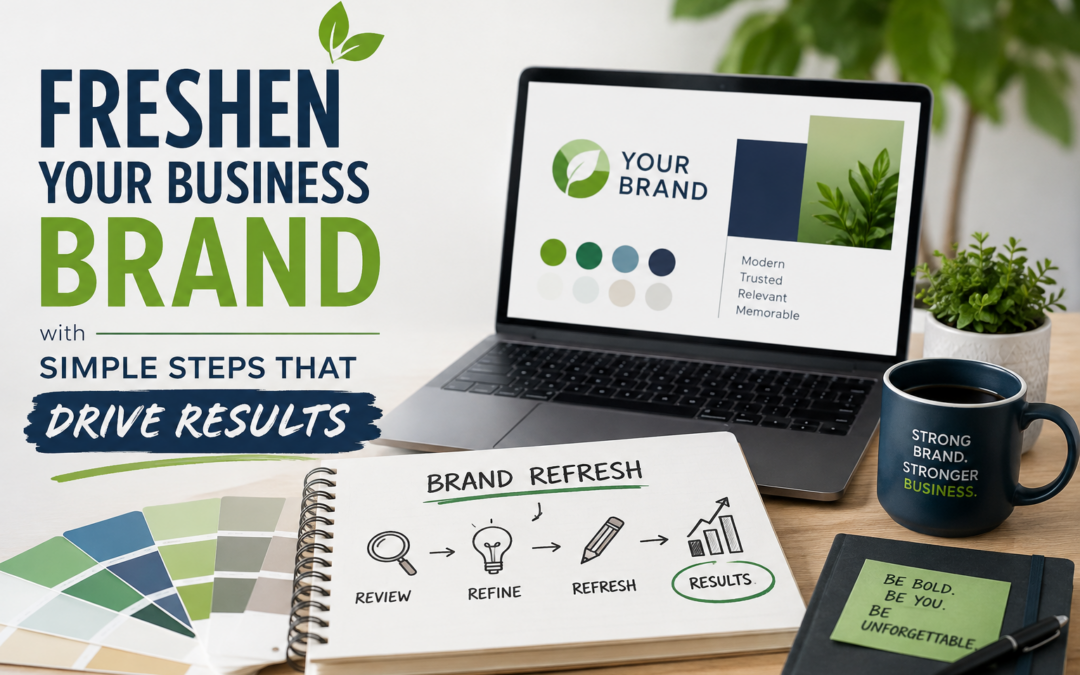
Small business owners can feel the squeeze when a solid product and great service still aren’t translating into steady attention. The challenge often isn’t the business itself, it’s that the brand signals have gotten a little out of sync with what customers need now, which quietly weakens customer engagement. A focused brand refresh helps restore market relevance, clarify value at a glance, and create sharper brand differentiation in a crowded space. The payoff is real, practical business rebranding benefits that make the business easier to choose.
How a Brand Refresh Becomes Strategic
A brand refresh works best when three pieces move together: staying relevant, inviting past customers back, and standing out from alternatives. Done well, it is updating brand identity so people recognize you faster and feel clearer about what you deliver.
This matters because relevance earns attention, re-engagement rebuilds trust, and differentiation makes choosing you feel easy. When those align, your market positioning improves and the brand starts to “stick” in people’s minds, which grows brand equity over time.
Think of a neighborhood café that updates its menu language, photos, and signage to match how people order today. If it also highlights one signature offering and reconnects with regulars, it can lift confidence, since 68% of customers say trust matters more as AI advances. With that clarity, it’s easier to tie each refresh choice to skills like analysis, fundamentals, leadership, and strategy.
Build the Strategy Muscles Behind a Smarter Brand Refresh
Once you know why you’re refreshing, the next step is making choices that are guided by insight, not just taste. Earning a business management degree can sharpen the strategic thinking that supports every stage of a brand refresh, from reading your market to spotting what customers are really responding to. It also strengthens core marketing fundamentals and leadership skills, so you can align your updated brand with clearer priorities and more confident decision-making. If you’re balancing growth with learning, an online undergrad in business management can make it easier to keep running your business while you’re in school. With that strategic foundation in mind, you’ll be ready to apply the upcoming checklist to your logo, messaging, and packaging with purpose.
Use This Brand Refresh Checklist (Logo to Packaging)
A good brand refresh isn’t about changing everything, it’s about choosing the few updates that best match what your market wants and what your strategy can actually support. Use this checklist to make smart, contained improvements you can roll out with confidence.
- Audit every brand touchpoint before you change anything: Start by creating one master list of where your brand shows up, then mark each item “keep,” “update,” or “retire.” A helpful starting prompt is to list every place your brand currently appears such as your website, social profiles, proposals, email signatures, signage, and product packaging. This inventory keeps your refresh aligned with the strategy work you’ve already done, especially your priorities, budget, and timeline.
- Tighten your mission statement so it’s useful (not poetic): In 20 minutes, rewrite your mission statement to answer three questions: who you serve, what you help them do, and how you do it differently. Then test it against real decisions: “Would this statement help us pick which services to promote?” and “Would it guide our tone on the website?” If it can’t steer choices, simplify it until it can.
- Create a brand slogan you can actually use everywhere: Draft 10 options, then narrow to 2–3 based on clarity and specificity, avoid generic promises like “quality” or “best service.” A strong slogan usually fits one of these patterns: outcome + audience (e.g., “Quick bookkeeping for busy contractors”) or value + method (e.g., “Clean meals, ready in 10”). Read it out loud in a voicemail greeting and on a homepage headline; if it feels awkward, keep refining.
- Refresh brand colors with accessibility and consistency in mind: Choose a small, controlled palette: 1 primary color, 1 secondary, and 1 accent, plus neutrals for text and backgrounds. Then assign jobs to each color (primary for buttons, accent for highlights, neutrals for readability) so your team stops “winging it.” This kind of system supports the brand strategy muscle of consistency, your audience should recognize you even before they read a word.
- Approach logo redesign like a “refine,” not a restart: Keep one recognizable element (shape, symbol, or letterform) and improve clarity at small sizes first, think social icons, packaging, and mobile headers. Ask for versions that work in one color and in black-and-white; if it fails there, it will struggle everywhere. A logo update works best when it’s tied to your positioning, not just your taste.
- Website revamp: fix the message before the layout: Start with your homepage and one key conversion page (booking, product, or contact). In a single afternoon, rewrite the top section to include: who it’s for, what problem you solve, one proof point (testimonial or result), and one clear call-to-action. Then do a quick “5-minute test” with a customer: if they can’t explain what you do and what to click next, you’ve found your priority fix.
- Redevelop product packaging to reduce confusion and increase trust: First, list the top 3 questions customers ask before buying, then make sure the packaging answers them fast (what it is, who it’s for, how to use it). Keep the design aligned to your updated colors and logo, and add one “decision helper” like a simple benefit badge or usage instruction panel. Packaging is a silent salesperson, clarity often beats cleverness.
- Incorporate customer feedback in a structured, low-drama way: Collect feedback in two short rounds: 5–8 existing customers and 5–8 “almost customers” who considered you but didn’t buy. Ask the same three questions every time: what you expected, what confused you, and what would make you recommend the brand. You’re not looking for unanimous votes, you’re looking for patterns you can act on.
Brand Refresh FAQs: Timelines, Costs, and Results
Q: What’s the difference between a brand refresh and a full rebrand?
A: A refresh updates key elements without changing who you are at the core. A full rebrand usually means your corporate image is changed with broader shifts like naming, positioning, and visual identity. If your audience still trusts you, a refresh is often enough.
Q: How long does a typical brand refresh take if I’m not changing everything?
A: Many small businesses can roll out a focused refresh in 2 to 6 weeks. Plan extra time if you have lots of assets like proposals, packaging, or multiple web pages. The fastest path is updating your top revenue pages and customer-facing materials first.
Q: How much should I budget for a simple brand update?
A: Costs vary, but you can control them by prioritizing high-impact touchpoints and reusing what already works. Ask for itemized quotes and choose a “phase one” scope that covers messaging and your website essentials. If money is tight, start with copy and a tighter visual system before redesigning everything.
Q: How will customers react to the changes, and how do I avoid confusing them?
A: Customers usually accept updates when the experience stays familiar and the benefits get clearer. Keep one or two recognizable cues, and explain the “why” in a short email or pinned post. If you sell in person, give your team a simple script so everyone communicates the same story.
Q: How do I measure whether the refresh is actually working?
A: Track a few outcomes that connect to revenue, like leads, conversion rate, repeat purchases, or referrals. Be careful with vanity metrics like raw follower counts that look good but do not prove growth. Set a baseline before launch, then review results at 30, 60, and 90 days.
Make One Brand Refresh Choice That Builds Loyalty and Growth
It’s easy to feel stuck between wanting a fresher look and worrying about costs, timelines, or confusing the customers who already trust the business. The steady approach is brand identity renewal through small, intentional improvements, guided by clarity, consistency, and real feedback, so implementing brand changes feels manageable instead of risky. With brand refresh motivation and simple tracking, the result is tighter recognition, stronger customer loyalty building, and more business growth through branding over time. A brand refresh works best when it’s consistent, not rushed.