
For event planners managing packed calendars, shifting client expectations, and nonstop details, the Sunday Scaries can feel like the week starts before Monday arrives. This kind of workweek anxiety often shows up as a mental rerun of timelines, vendor follow-ups, and what might go wrong, even during downtime. When event planning stress becomes the default, it can tip into professional burnout and quietly create a real stress impact on productivity before the first email is even opened. Naming the pattern makes Monday feel more manageable.
Calm Monday in 30 Minutes: A Sunday Prep Plan
When Sunday Scaries hit, it’s usually because your brain is trying to protect you from uncertainty: the unknown inbox, the fragile timeline, the client who “might” change everything. This 30-minute routine turns those planning triggers into a short, doable plan you can trust.
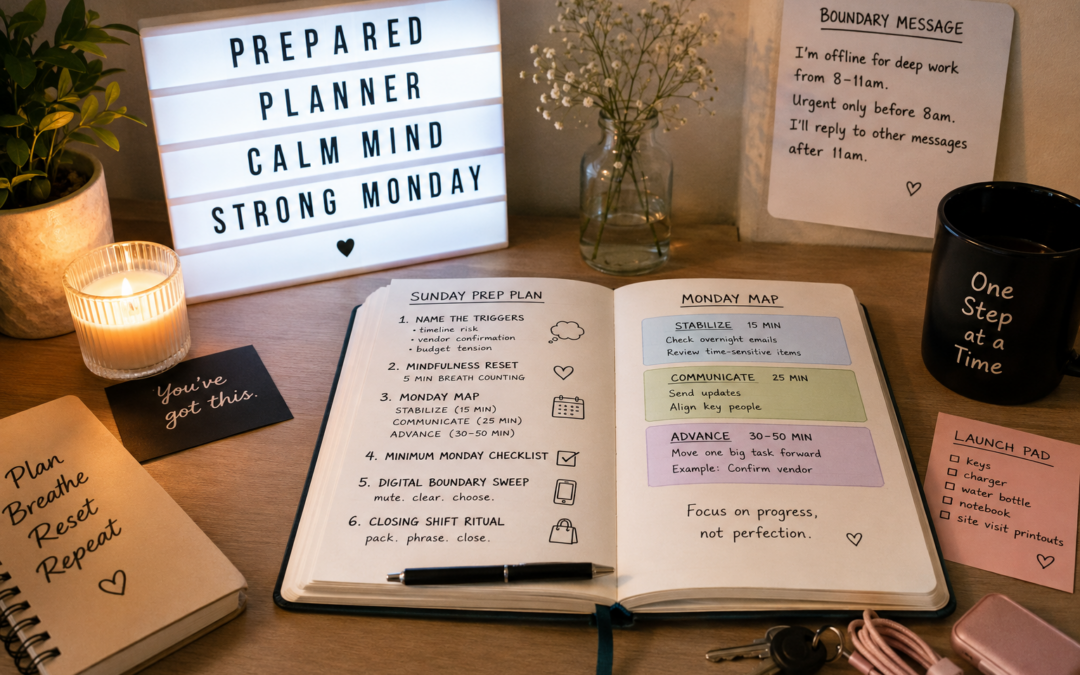
- 2-minute “name the triggers” brain dump: Write three quick bullets: What am I afraid will happen Monday? and what’s the earliest moment it could go wrong? Naming the trigger (timeline risk, vendor confirmation, budget tension, team coverage) shrinks the mental fog and tells you what actually needs attention. End with one sentence: “If I handle ___, Monday is already better.”
- 5-minute mindfulness reset (one simple anchor): Sit down, set a timer, and do easy breath counting: inhale 1, exhale 2… up to 10, then start over. When your mind jumps to seating charts or load-in timing, gently label it “planning” and return to the count, this is the stress-management technique.
- 10-minute “Monday Map” time block: Open your calendar (or paper planner) and block the first 60–90 minutes of Monday into three chunks: Stabilize (15 min), Communicate (25 min), Advance (30–50 min). Stabilize is checking what’s time-sensitive (overnight emails, weekend changes). Communicate is one short update to the key people. Advance is one concrete task that moves the event forward (confirming a vendor, finalizing a run-of-show draft).
- 7-minute “Minimum Monday” checklist (only what reduces uncertainty): Keep it light: 5–7 items max. Examples: confirm first meeting location/link, identify top three deliverables, list who you need from and by when, pull one critical file to the top of your drive, and write a two-line status update you can paste into a message. This is an anxiety reduction strategy because it lowers decision fatigue at the exact moment you’re most vulnerable.
- 3-minute digital boundary sweep: Silence non-urgent notifications, clear your lock screen, and choose one “check window” for email Monday morning. If digital chaos is one of your triggers, a quick pass to mute alerts can prevent your nervous system from starting the week in reactive mode.
- 3-minute “closing shift” ritual: Put your Monday essentials in one place: water, a snack, charger, notepad, and any printed materials for site visits. Then choose a shutdown phrase like, “I’ve prepared enough to start,” and physically close your laptop. The point isn’t perfection, it’s giving your brain a clear off-ramp so you can actually rest.
Try 4 Gentle Add-Ons for Stress Relief (Herbal to Breathwork)
Once your Sunday plan is set, a few gentle add-ons can help your body actually feel safer and steadier.
- Breathing technique: Try slow, even breaths to nudge your nervous system toward calm.
- Progressive muscle relaxation: Tense and release muscle groups to let physical stress unwind.
- Ashwagandha: Consider this herbal option for stress support, and check that it’s appropriate for you.
- THCa: If you’re exploring this route, you can take a closer look to learn more.
Sunday Habits That Make Monday Feel Manageable
When your calendar is unpredictable, habits act like anchors. These small practices help event planners and anyone with a busy life reduce Sunday dread by making Monday feel prepared, not threatening.
Monday Map in 10 Minutes
- What it is: Write the top three outcomes and first steps for Monday.
- How often: Weekly, Sunday evening.
- Why it helps: It reduces ambiguity, which often fuels anxious spirals.
Two-Sentence Boundary Message
- What it is: Draft a short note stating hours, urgency rules, and next response time.
- How often: Weekly, before Monday.
- Why it helps: It prevents other people’s panic from becoming your plan.
Phone Curfew and Charge Outside
- What it is: Set a hard stop for scrolling and charge your phone away from bed.
- How often: Nightly.
- Why it helps: Better wind-down supports more consistent sleep.
Sleep Hygiene Reset
- What it is: Use the sleep environment and behavior checklist: cool room, dim lights, predictable bedtime.
- How often: Nightly.
- Why it helps: A calmer night often creates a steadier Monday morning.
Pack-and-Place Launch Pad
- What it is: Put keys, charger, water, and Monday essentials in one visible spot.
- How often: Weekly.
- Why it helps: Fewer morning decisions means less stress.
Sunday Scaries Questions Event Planners Ask
Q: What are the early signs my Sunday Scaries are turning into real stress?
A: Watch for patterns like a tight chest, headaches, stomach flips, irritability, or racing thoughts that show up most Sundays. The World Health Organization describes stress as mental strain from challenging circumstances, so your body cues are valid data. Jot down what time symptoms start and what you were doing right before.
Q: How do I tell anxiety from “I’m just unprepared for Monday”?
A: If a quick plan makes you feel noticeably calmer, you were likely missing clarity. If your mind keeps scanning for disasters even after a simple checklist, you may be dealing with anxiety that needs extra support. Try a single small action, then reassess your intensity level.
Q: How should I adjust coping tools during peak season when there’s no real downtime?
A: Shrink the habit until it is frictionless: two minutes of planning, one boundary line, five slow breaths. Keep one non negotiable recovery block, even if it is just a 15 minute walk or a shower with no phone. Consistency matters more than duration when life is stacked.
Q: When is it time to get professional support instead of trying more self help?
A: Reach out if sleep is regularly disrupted, panic symptoms show up, you are using alcohol or scrolling to numb out, or your mood is affecting relationships. If you have thoughts of self harm, seek urgent help immediately. A therapist or coach can help you build skills tailored to your specific triggers.
Q: Can I have Sunday Scaries even if I like my job and my clients?
A: Yes, and it is common. Many professionals experience Sunday Scaries even when work is meaningful, because the transition back to responsibility can feel intense. Treat it like a nervous system signal, not a character flaw.
Resetting Your Sunday Mindset for a Stronger Monday Start
When Sunday night arrives, it’s easy for looming timelines, client expectations, and what-ifs to crowd out rest, especially in event planning. The steadier way forward is the mindset this guide emphasizes: notice the stress signals, respond with self-compassion, and choose support that fits the season, building stress resilience over time. With consistent positive mindset cultivation, anxiety becomes information rather than a takeover, and event planner wellbeing stops being optional and starts being protected. Monday feels lighter when you stop trying to control everything and start building a reliable reset.